GEOTECHNICALENGINEERING
ST. JOHNS NEWFOUNDLAND
HomeIn-Situ TestingField permeability test (Lefranc/Lugeon)

Field Permeability Testing in St. John’s: Lefranc & Lugeon in Rock and Overburden

Sound ground. Sound decisions.

LEARN MORE

St. John’s sits at the eastern edge of the Avalon Peninsula, where the population of roughly 110,000 contends with a landscape carved by glaciation and exposed to North Atlantic weather. Most of the city rests on the Signal Hill Formation—a collection of folded sandstones and shales—capped by a discontinuous blanket of glacial till that can vary from bouldery lenses to dense, silty matrix within a single block. When a site investigation stops at borehole logging, the actual rate at which water moves through these fissures remains guesswork. The field permeability test (Lefranc/Lugeon) resolves that directly by injecting or withdrawing water at discrete intervals, yielding a formation-scale conductivity value that laboratory specimens cannot reproduce. In projects near Quidi Vidi Lake or along Water Street, where groundwater control dictates excavation safety and foundation performance, the in-situ permeability procedure becomes the decisive link between desk study assumptions and construction reality.

A single Lugeon stage at 4 bar in fractured Signal Hill sandstone can reveal more about water inflow risk than a hundred lab permeability specimens.
Our service areas

How we work

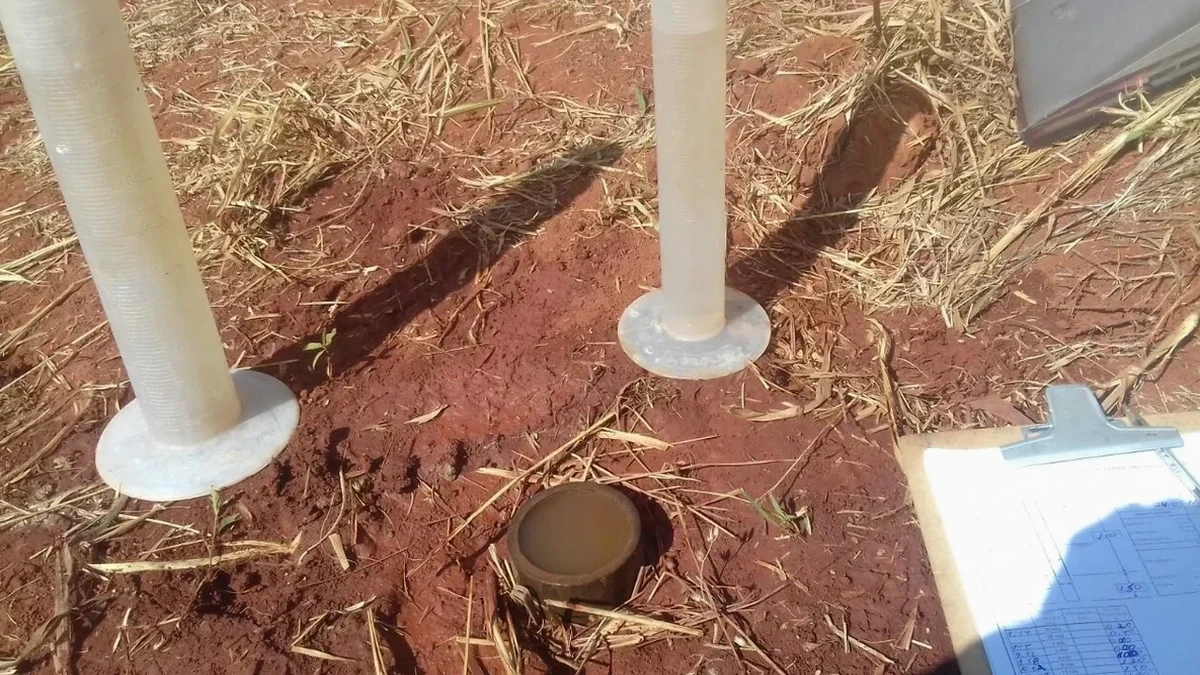
A recurring error we see in St. John’s specifications is ordering only laboratory permeability on intact rock core when the dominant flow is fracture-controlled—this yields conductivities three to four orders of magnitude lower than what the ground actually transmits. The Lugeon test corrects that by pressurizing a borehole interval with clean water and measuring the take rate at increasing and then decreasing pressure heads, allowing the interpreter to distinguish between tight rock, fracture wash-out, and hydraulic jacking of bedding planes. In overburden, the Lefranc method uses a similar principle but operates at lower pressures suitable for granular soils, where maintaining a constant head during injection reveals both the saturated conductivity and any tendency toward internal clogging. For dewatering design where the footings will bear on weathered sandstone, we often recommend running Lefranc tests in the residual soil zone immediately above bedrock—this transition layer frequently governs upward seepage gradients during wet-season pumping. Every test string is calibrated with a field barometric logger to correct for atmospheric drift, and water temperature is recorded because St. John’s groundwater at 6–8 °C measurably affects viscosity and, consequently, the computed hydraulic conductivity.
Field Permeability Testing in St. John’s: Lefranc & Lugeon in Rock and Overburden
Technical reference — St. Johns Newfoundland

Local geotechnical context

The difference between a site on The Battery’s steep rock slopes and one on the flat, infilled terrain around Stavanger Drive is stark—fracture connectivity in the former can produce Lugeon values exceeding 30 units, signaling open conduits, while the latter’s dense till often yields Lefranc conductivities in the range of 1 × 10⁻⁶ m/s. Treating both with the same dewatering plan is a costly mistake. The most serious consequence we encounter in St. John’s is not just flooding during excavation; it is internal erosion of fines from glacial deposits adjacent to bedrock drains, a mechanism that has triggered settlement under slab-on-grade foundations in commercial parks. A field permeability test program that includes falling-head stages in soil and multi-pressure steps in rock provides the differential dataset needed to separate tight aquitards from water-bearing fractures. When coupled with a triaxial evaluation of the till matrix, the engineer gains both mass permeability and effective strength—two parameters that must be read together when designing underdrains or assessing long-term seepage forces against retaining structures.

Need a geotechnical assessment?

Reply within 24h.

Email: [email protected]

Relevant standards

NBCC Part 4 – groundwater and foundation drainage provisions, CSA A23.3 – design of concrete structures with reference to aggressive groundwater, ASTM D6391 – standard test method for field measurement of hydraulic conductivity using borehole infiltration, Houlsby (1976) – interpretation of Lugeon water-pressure tests in rock

Typical values

ParameterTypical value
Test methodLefranc (variable head), Lugeon (constant pressure steps)
Applicable materialsGlacial till, fractured sandstone, shale, residual soil
Pressure range0.5 to 10 bar (Lugeon), <1 bar (Lefranc)
Packer typePneumatic single or double packer, 74–150 mm borehole
Measurement resolution±0.1 L/min flow, ±0.5 kPa pressure transducer
Reporting standardNBCC Part 4, CSA A23.3 groundwater clauses, Houlsby interpretation

Questions and answers

When is a Lugeon test preferred over a Lefranc test in St. John’s geology?

The Lugeon test is the appropriate choice once the borehole penetrates into the Signal Hill Formation bedrock, typically at depths of 2 to 15 metres depending on the neighborhood. The method applies controlled pressures—commonly 0.5 to 10 bar—to a packed-off interval and measures the water take in litres per minute per metre of test section. This quantifies fracture aperture and interconnectivity, which the Lefranc test in overlying till cannot address. In practice, most St. John’s projects require both: Lefranc in the glacial cover for excavation dewatering, and Lugeon in the underlying rock for assessing foundation drainage and potential grouting needs.

What does a field permeability test cost in the St. John’s area?

A Lefranc or Lugeon test program in St. John’s generally falls between CA$770 and CA$1,420 per test interval, with the final figure depending on the number of depths, the need for packer systems, and whether the borehole is cased through overburden. Mobilization to sites on the Avalon Peninsula is included in the quoted range for most urban locations, though remote access or very steep slope setups may require a site-specific estimate.

How long does it take to get results from a permeability test program?

Field execution for a typical three-depth Lugeon profile plus two Lefranc intervals in the overburden takes one to two working days on site once the borehole is advanced and stable. Water level stabilization before testing can add several hours per zone in low-conductivity silts. We deliver interpreted results—including Lugeon value plots, Lefranc conductivity calculations, and a summary table—within four business days of completing field work. Expedited reporting is available for active dewatering operations.

Location and service area

We serve projects in St. Johns Newfoundland and surrounding areas.

View larger map