GEOTECHNICALENGINEERING
ST. JOHNS NEWFOUNDLAND
HomeIn-Situ TestingField density test (sand cone method)

Field Density Testing in St. John’s: Sand Cone Method Compliance

Sound ground. Sound decisions.

LEARN MORE

Compaction control in St. John’s isn’t just a box-ticking exercise—it’s the primary defense against differential settlement in a city where glacial till meets marine clay, and where freeze-thaw cycles tear apart poorly compacted fill within two winters. The National Building Code of Canada (NBCC 2020) references ASTM D1556 as the standard for in-place density measurement via the sand cone method, and on the Avalon Peninsula, that method remains the most practical choice for granular backfill verification. The local geology, shaped by the Appalachian orogeny and subsequent glaciation, leaves contractors navigating everything from weathered sandstone bedrock at Signal Hill to soft, compressible silts in the Waterford Valley. Getting a reliable field density test means dealing with wind off the North Atlantic, short construction seasons, and moisture contents that fluctuate dramatically between morning fog and afternoon sun. We run these tests alongside supporting lab work to close the loop between field performance and material specification, ensuring that what goes into the trench actually stays there without creating problems for the foundation crew six months later.

A sand cone test on the Avalon doesn't measure effort—it measures result. If the Proctor curve isn't matched to the actual quarry source, the 98% on your report is just a number.
Our service areas

How we work

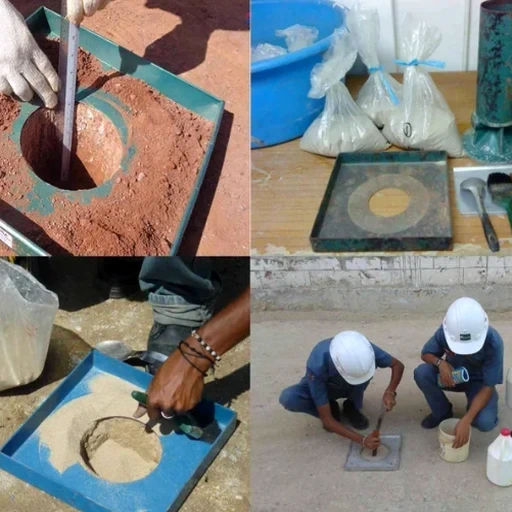
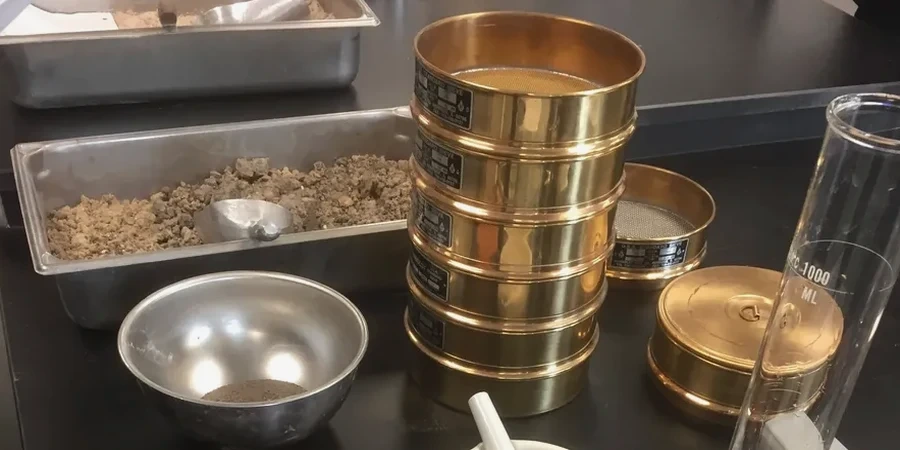
On sites around Kenmount Road or out toward Portugal Cove-St. Philip’s, we often see imported granulars that look great on the gradation cert but fall apart under a nuclear gauge because of mineralogy issues the lab report never flagged. That’s why the sand cone remains the referee test—it’s slow, it’s manual, but it doesn’t lie about density the way indirect methods can when crushed shale is in the mix. The procedure per ASTM D1556 involves excavating a test hole, capturing all removed material, weighing it, and backfilling the cavity with calibrated Ottawa sand through a density apparatus cone. The difference between the sand volume and the excavated mass gives you the wet density; pair that with a moisture content from a field sample and you have dry density to compare against the Modified Proctor maximum. In St. John’s, where imported fill often travels from quarries in the central Avalon, the lab ASTM D1557 Proctor curve has to match the exact source material—not a generic regional default—or the percent compaction numbers mean nothing. For deeper layers or mixed fills where grain size distribution matters, we connect the density results with a grain size analysis to verify that the material still meets the spec gradation envelope after placement and compaction. It’s common practice here to run one field density test per 150 mm of lift thickness per 500 m² of fill, though the city’s own engineering standards may tighten that spacing for structural backfill adjacent to foundation walls.
Field Density Testing in St. John’s: Sand Cone Method Compliance
Technical reference — St. Johns Newfoundland

Local geotechnical context

A twelve-unit condo development off Torbay Road had backfill placed in late November, just ahead of the first freeze. The compaction test reports showed 97% of Modified Proctor, and the geotechnical sign-off was issued before Christmas. By April, the sidewalk slabs along the east elevation had rotated outward 40 mm, and a storm drain connection had sheared. The investigation was straightforward: the fill had been placed partially frozen, the sand cone test had sampled the top 100 mm of a lift that had been thawed and recompaacted at the surface while the underlying material remained ice-locked. When the thaw finally reached depth in March, the lower portion of the lift consolidated under its own weight, and the surface settlement followed. In St. John’s, where the frost depth can exceed 1.2 m in an exposed site, field density testing outside the May-through-October window demands rigorous material temperature documentation and a hard stop when aggregate stockpiles show frost at the loader face. The sand cone method is inherently a point-in-time surface test—it cannot detect frozen layers beneath the test zone unless the operator probes the excavation floor and records the observation. That observation, or lack of it, becomes the single most important line on the field report when things go wrong.

Need a geotechnical assessment?

Reply within 24h.

Email: [email protected]

Relevant standards

ASTM D1556: Standard Test Method for Density and Unit Weight of Soil in Place by Sand-Cone Method, ASTM D1557: Standard Test Methods for Laboratory Compaction Characteristics of Soil Using Modified Effort, NBCC 2020: National Building Code of Canada (geotechnical and foundation provisions), CSA A23.3: Design of Concrete Structures (referenced for compaction beneath slabs-on-grade), City of St. John's Municipal Specifications for Earthworks and Grading

Typical values

ParameterTypical value
Test StandardASTM D1556 / ASTM D1557
Test Depth RangeUp to 150 mm per test lift
Applicable MaterialsGranular soils with max particle size ≤ 50 mm
Calibration MediumGraded Ottawa sand (bulk density calibrated on site)
Key OutputsWet density, dry density, percent compaction, moisture content
Typical St. John's Backfill Spec95% to 98% Standard Proctor per NBCC / city spec
Cold Weather NoteFrozen material rejected; test only on thawed, workable fill

Questions and answers

How much does a sand cone density test cost in St. John's?

For projects in the St. John's metro area, field density testing by sand cone method typically runs between CA$120 and CA$210 per test, depending on site location, number of tests per mobilization, and whether a matching Proctor curve needs to be developed in the lab. Remote sites on the Avalon Peninsula or beyond may incur additional travel charges. We quote a flat day rate plus per-test pricing so you know the total before we mobilize.

How many density tests does the City of St. John's require for trench backfill?

City specifications generally follow NBCC guidance, requiring one field density test per lift per 500 m² of fill area, with a minimum of one test per lift for narrow trench backfill. For water and sewer trenches in city right-of-ways, the municipal inspector may tighten this to one test every 30 linear meters per lift. We coordinate with the inspector on site to ensure the testing frequency meets the permit conditions before backfill placement begins.

Can the sand cone test be used in wet or frozen soil?

The sand cone method per ASTM D1556 is not reliable in frozen soil or saturated, free-draining granulars. In St. John's, where late-fall construction frequently bumps against freeze-up, we enforce a material temperature check: if the fill contains visible ice lenses or the aggregate stockpile face is frozen, testing is suspended until material conditions improve. For wet but unfrozen silty sands common in the Waterford Valley, we can still obtain valid results as long as the test hole excavation remains stable and the sand pouring is not disrupted by groundwater inflow.

What's the difference between a sand cone test and a nuclear density gauge?

The sand cone is a direct measurement method: you physically excavate soil, weigh it, and measure the hole volume with calibrated sand. A nuclear gauge estimates density indirectly by measuring radiation attenuation through the soil. In St. John's, where crushed shale and aggregate with variable mineralogy are common, nuclear gauge readings can drift from true density because the device's calibration curve may not match the local material chemistry. The sand cone serves as the referee test, and many city inspectors specifically require it for final acceptance of structural backfill.

Do I need a Proctor test before field density testing can start?

Yes—the field density result is meaningless without a laboratory Proctor curve to compare it against. The Proctor test (ASTM D1557 or D698) establishes the maximum dry density and optimum moisture content for your specific fill material. We recommend sending a bulk sample of the import fill to the lab at least five business days before placement begins. If the quarry source changes mid-project, the Proctor must be re-run; two loads from different Avalon quarries can have maximum dry densities differing by 80 kg/m³ or more.

Location and service area

We serve projects in St. Johns Newfoundland and surrounding areas. More info.

View larger map