GEOTECHNICALENGINEERING
ST. JOHNS NEWFOUNDLAND
HomeGeophysicsElectrical resistivity / VES (Vertical Electrical Sounding)

Electrical Resistivity Testing & VES for Subsurface Characterization in St. John's

Sound ground. Sound decisions.

LEARN MORE

In St. John's, many of the older neighborhoods sit on a thin veneer of glacial till draped over steeply dipping Ordovician shales and sandstones. You see it clearly during excavation on the Southside Hills—what looks like solid ground can mask a highly variable bedrock surface just a few meters down. We rely on electrical resistivity testing and VES to map that hidden interface without poking dozens of boreholes. The marine clay pockets in the Waterford Valley also show a distinct low-resistivity signature, which helps us delineate compressible zones before foundation design begins. For deeper infrastructure, like the buried utilities along Kenmount Road, a seismic refraction survey sometimes complements the resistivity lines when we need both a velocity model and a resistivity profile to confirm weathered versus competent rock.

Resistivity profiling in St. John’s provides a non-invasive way to map bedrock depth and saline water boundaries, two of the most common geotechnical concerns across the Avalon Peninsula.
Our service areas

How we work

A recent project near Quidi Vidi Lake required precise location of the water table and saltwater wedge influence for a new commercial building. We deployed a Wenner array VES with maximum electrode spacing of 100 meters, penetrating roughly 20 to 25 meters into the subsurface. The resulting resistivity curve revealed three distinct layers: a high-resistivity dry overburden above 800 ohm-m, a saturated silty sand around 120 ohm-m, and a low-resistivity zone below 30 ohm-m consistent with brackish groundwater intrusion from the harbor. This type of layered detail is critical in St. John’s, where coastal proximity and fractured bedrock create complex hydrogeological conditions. The method works well even in winter, provided we get good electrode coupling through the frozen crust—common in the airport area where surficial frost can reach 40 cm depth.
Electrical Resistivity Testing & VES for Subsurface Characterization in St. John's
Technical reference — St. Johns Newfoundland

Local geotechnical context

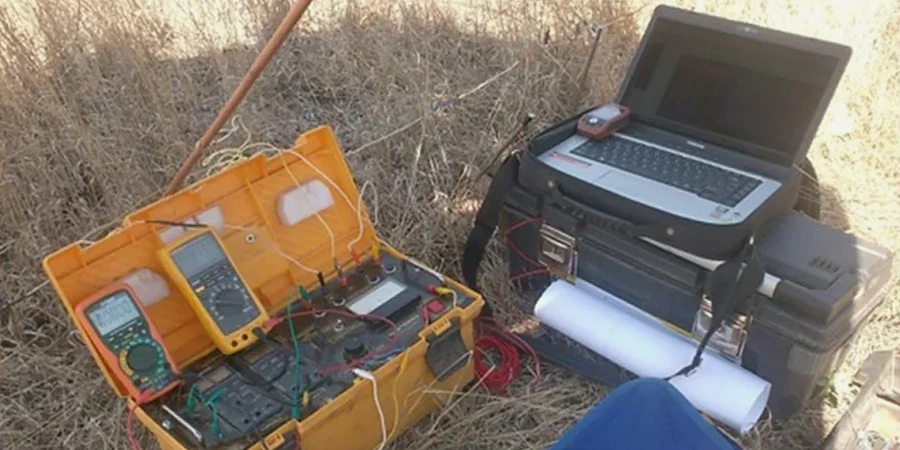
The equipment itself is straightforward: a resistivity meter, a set of stainless steel electrodes, and heavy-gauge cables on reels. The real challenge in St. John’s is ground coupling. The Signal Hill formation weathers into a thin, stony soil that makes driving electrodes difficult—we often switch to bentonite paste or saline water at each electrode stake to reduce contact resistance below 2 kΩ. Another risk is interpreting data across the city’s historic fill zones. Old St. John’s burned several times, and buried debris, ash layers, and rubble foundations create erratic resistivity anomalies that can be mistaken for natural stratigraphy unless calibrated with at least one test pit or borehole log. Without that ground-truth, a resistivity section in the downtown core can lead to costly misinterpretation of bearing strata.

Need a geotechnical assessment?

Reply within 24h.

Email: [email protected]

Explanatory video

Relevant standards

ASTM D6431-18: Standard Guide for Using the DC Resistivity Method for Subsurface Investigation, NBCC 2020: National Building Code of Canada, geotechnical site investigation requirements, CSA A23.3: Design of Concrete Structures, referencing geotechnical parameters

Typical values

ParameterTypical value
Array configurationWenner, Schlumberger, dipole-dipole
Typical investigation depth (VES)1 to 80 m depending on AB/2 spacing
Measured parameterApparent resistivity (Ω·m)
Common target detectionBedrock surface, water table, saline/fresh interface, permafrost
Electrode array length (2D profiling)Up to 200 m per spread
Applicable standardASTM D6431-18
Data acquisitionMulti-electrode system with automatic switching

Questions and answers

How much does an electrical resistivity survey cost in St. John’s?

For typical geotechnical applications in the St. John’s area, an electrical resistivity or VES survey generally ranges from CA$970 to CA$1,300 per day of field work. The total depends on line length, number of soundings, and terrain accessibility. Sites on steep slopes like the Southside Hills or those requiring extensive clearing add to mobilization time. We provide a fixed-price proposal after reviewing your site plan.

What depth can VES reach in the St. John’s area?

With a standard Schlumberger array using a maximum current electrode half-spacing (AB/2) of 100 meters, we typically achieve an investigation depth of 20 to 30 meters in the glacial till and shale bedrock common around St. John’s. Greater depths are possible with larger spreads, but urban site constraints often limit the available space.

Does frozen ground affect resistivity readings?

Yes, frozen ground shows a sharp increase in resistivity because ice is an electrical insulator. In St. John’s, where winter frost can penetrate 30 to 50 cm, the near-surface layer will read significantly higher than the same soil in summer. We account for this in processing and, where possible, schedule surveys between May and November to minimize seasonal effects on the interpretation.

Location and service area

We serve projects in St. Johns Newfoundland and surrounding areas.

View larger map