GEOTECHNICALENGINEERING
ST. JOHNS NEWFOUNDLAND
HomeSeismicBase isolation seismic design

Base Isolation Seismic Design for St. John's Structures

Sound ground. Sound decisions.

LEARN MORE

The contrast between the historic rowhouses clinging to Signal Hill and the modern institutional buildings on the Memorial University campus is stark, but beneath both lies a shared structural challenge. St. John's sits on a foundation of massive Ordovician sandstone and shale, a legacy of the ancient Iapetus Ocean that shapes our seismic response. While the rock provides excellent bearing capacity, its high stiffness transmits seismic waves with less energy dissipation than soil would, meaning our isolation systems must be tuned precisely to the recorded motions of the 2021 and 2023 earthquakes that reminded the city of our moderate yet real seismic hazard. The design for the new Core Science Facility involved seismic refraction profiling to map bedrock depth variations before finalizing isolator parameters. A thorough grain size analysis of any overburden helps us differentiate true rock sites from those with thin mineral soil veneers that can alter site classification, while our triaxial testing on rock cores ensures the substrate can handle the concentrated forces that isolators transfer during a design-level event.

A well-tuned base isolation system in St. John's can cut seismic forces by 60 to 80 percent, but only if the geotechnical model accurately captures the stiffness contrast at the rock-head.

Our service areas

How we work

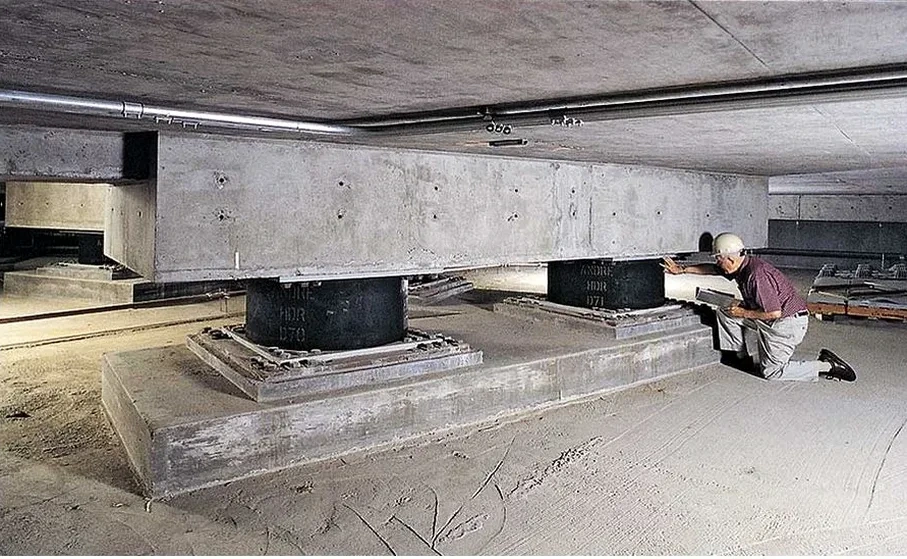
The 2020 National Building Code of Canada (NBCC 2020) assigns St. John's a Site Class C by default, but the reality is that much of the city rests on Class A or B rock, which fundamentally alters the spectral acceleration values for design. Article 4.1.8.12 of NBCC 2020 specifically governs seismic isolation provisions, requiring that isolators be tested for the full range of thermal displacements our Newfoundland climate demands—from the minus 15°C deep winter soak to the plus 25°C summer peak that creates significant movement in bridges and parking structures. Each isolator system we design undergoes nonlinear time-history analysis using ground motion records scaled to the uniform hazard spectrum for the St. John's region, a process that requires integrating geotechnical site response with structural dynamics. The lead-rubber bearings or friction pendulum systems we specify must accommodate the 500-year return period event without residual displacement, a performance threshold that demands iterative collaboration between our geotechnical team and the structural engineer of record. When working on sites with fractured shale near Quidi Vidi Lake, we combine our analysis with slope stability assessment to verify that the increased period of the isolated structure doesn't introduce unforeseen resonance with adjacent slopes.
Base Isolation Seismic Design for St. John's Structures
Technical reference — St. Johns Newfoundland

Local geotechnical context

St. John's grew outward from the harbour in a pattern dictated by topography, with early development hugging the lower slopes while later subdivisions pushed onto the exposed bedrock plateaus of the east end. This historical spread means that adjacent buildings often occupy different site classes—one on massive sandstone, its neighbor on a thin till veneer—and that discrepancy can generate pounding risks if isolation gaps aren't coordinated. The 1929 Grand Banks earthquake, though centered offshore, caused damage in the city and remains a reminder that the Laurentian Slope seismogenic zone can produce magnitude 7 events. A non-isolated building on Class C soil in the Kenmount Road area may experience amplification that an isolated structure on the same site would largely bypass, but only if the isolator design accounts for near-source pulse effects and the possibility of basin edge diffraction from the deep sedimentary wedge underlying the Avalon Peninsula. Ignoring these local propagation effects leads to underestimation of displacement demand and premature isolator failure.

Need a geotechnical assessment?

Reply within 24h.

Email: [email protected]

Relevant standards

NBCC 2020 (National Building Code of Canada) Part 4, CSA A23.3:19 – Design of Concrete Structures, CSA S6:19 – Canadian Highway Bridge Design Code (CHBDC), ASCE/SEI 7-22 – Minimum Design Loads (for isolator testing protocols), ASTM D4015 – Resonant Column Testing (rock dynamic properties)

Typical values

ParameterTypical value
Applicable NBCC EditionNBCC 2020 Part 4, Div. B
Site Class (Typical St. John's)Class A (hard rock) to Class C
Spectral Acceleration Sa(0.2s)0.26 – 0.34g depending on location
Isolator Types AnalyzedLRB, FPS, HDRB
Required Testing ProtocolCSA S6-19 / ASCE 7-22 compliant
Target Effective Damping15 – 30% critical
Minimum Isolator Displacement Capacity±250 mm for MCE level

Questions and answers

What does base isolation design cost for a building in St. John's?

For a typical mid-rise institutional or commercial building in the St. John's area, the combined geotechnical investigation, site-specific hazard analysis, and isolator design documentation generally falls between CA$5,460 and CA$11,420. The final number depends on the number of ground motion records analyzed, the isolator type, and the complexity of the rock anchorage details.

How does the NBCC 2020 treat base isolation differently from conventional design?

NBCC 2020 Article 4.1.8.12 permits a force reduction factor R_d R_o up to 4.0 for isolated structures, compared to 1.5 to 3.5 for fixed-base systems, provided the isolators meet the testing and modeling requirements of Clause 4.1.8.12.3. The code also mandates that the superstructure remain essentially elastic, which shifts the design focus toward displacement control and moat wall clearance rather than ductile detailing.

Can existing buildings in St. John's be retrofitted with base isolation?

Yes, and several heritage masonry structures in eastern Canada have been successfully retrofitted. The process involves temporarily supporting the building on jacking frames while cutting the columns or walls at the isolation plane. For St. John's rock-founded buildings, the primary challenge is creating a new sub-basement level for the isolators and moat walls without undermining the existing footings, which requires careful sequencing and often ground freezing or micro-pile underpinning during construction.

Location and service area

We serve projects in St. Johns Newfoundland and surrounding areas.

View larger map